VDF Flooring Rate per Sq Ft in India: What Decides the Price
Why VDF (Trimix) flooring rates vary so much between quotations, what each rate should include, and how to compare offers fairly.
"What is your rate per square foot?" is usually the first question in any VDF flooring enquiry. It is a fair question, but the honest answer is that the rate depends on what is included and on the site. Two quotations that both say "VDF flooring" can describe very different scopes of work.
This guide explains what drives the price of a VDF (Trimix) floor in India and how to compare quotations so the cheapest number is not hiding a weaker floor.
Labour-only or with materials
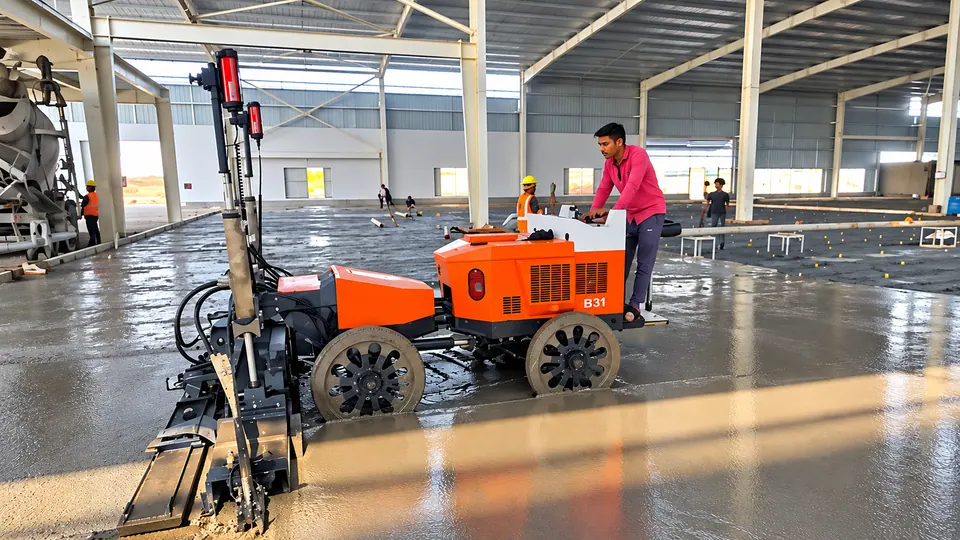
The biggest difference between rates is often what they include. Some contractors quote labour and equipment only — placing, vacuum dewatering, floating, trowelling and joint cutting — with the client supplying ready-mix concrete, reinforcement and hardener. Others quote a complete floor including concrete supply. Concrete is a large part of the cost, so these two kinds of rate cannot be compared directly.
Slab thickness and concrete grade
The thickness and grade of concrete come from the structural design and depend on the loads: racking legs, forklift wheel loads, vehicles and machines. A thicker slab or higher grade means more concrete per square foot and, for VDF, longer dewatering time per bay.
Area and pour planning
Larger floors are often more efficient per square foot because the crew and equipment work through long, continuous pour days. Small areas, many separate bays or frequent interruptions increase the cost per square foot because mobilisation and set-up are spread over less floor.
Hardener and finish
A standard power-trowelled VDF finish is the baseline. Dry-shake floor hardener improves abrasion resistance where traffic is heavy, but adds material and labour. Coloured hardeners, special textures or a later epoxy coating are further additions.
Joints and detailing
Saw-cutting of contraction joints is normally part of a VDF scope. Joint filling with semi-rigid fillers, armoured joints at heavy traffic routes, and detailing around pits, drains, columns and machine bases all add cost and should be listed clearly.
Site conditions
- Access for concrete trucks and pumps, and pumping distance
- Working hours, night pours or work around a live operation
- Readiness of the sub-base, levels and reinforcement before the crew arrives
- Water and power availability for the vacuum pump and finishing equipment
- Weather protection for curing in hot or rainy months
Location and mobilisation
Crews and equipment have to travel to the site. Projects far from the contractor's base carry travel, transport of equipment and accommodation costs, which matter more on smaller areas.
How to compare quotations fairly
- Send every contractor the same information: area, drawings, thickness, concrete grade, finish and expected dates
- Check whether concrete supply is included or not
- Check whether hardener, joint cutting, joint filling and curing are included
- Ask what equipment the contractor owns and operates on site
- Ask about supervision, daily output and how levels will be controlled
Why a public rate list can mislead
A single advertised rate per square foot cannot reflect thickness, scope and site conditions. It is usually either too high for a simple job or too low for a demanding one, with the difference recovered later through extras. A site-specific quotation is the only reliable number.
ASVDF Flooring prepares VDF and Trimix flooring quotations from your area, drawings and site details. Share them with us and we will send a clear, itemised quotation.
- VDF Flooring
- Trimix Flooring
- Flooring Cost