Vacuum dewatered flooring
VDF Flooring Services
VDF flooring — vacuum dewatered flooring, also widely called Trimix flooring in India — is a concrete floor system used where slabs need higher surface strength, better abrasion resistance, and a denser finish than ordinary concrete. ASVDF Flooring installs VDF floors for industrial, warehouse, and commercial buildings from the registered office in Shamshabad, Hyderabad, with project delivery all over India, including Hyderabad, Bengaluru, Chennai, Telangana, Andhra Pradesh, Karnataka, Maharashtra and Odisha.
What is VDF flooring?
VDF stands for vacuum dewatered flooring. After concrete is placed and levelled, vacuum mats extract surplus water from the slab surface. Lowering that water-cement ratio densifies the top layer, increases compressive strength, and leaves a tighter, more wear-resistant finish.
In Indian industrial construction the same system is also described as vacuum densification flooring or vacuum dewatering flooring. The job is the same: a heavy-duty concrete floor that can take forklifts, racking, and plant traffic without an early dusty, weak surface.
Where VDF flooring is used
VDF is specified on large, load-bearing slabs rather than as a decorative overlay. Typical applications include warehouses, manufacturing plants, logistics hubs, automobile units, food processing areas, and parking decks.
- Warehouse and logistics floors with pallet-mover and forklift traffic
- Factory and plant floors where abrasion and point loads matter
- Commercial halls and back-of-house areas that need a durable concrete finish
- Infrastructure slabs such as loading bays and parking areas
How we install VDF flooring
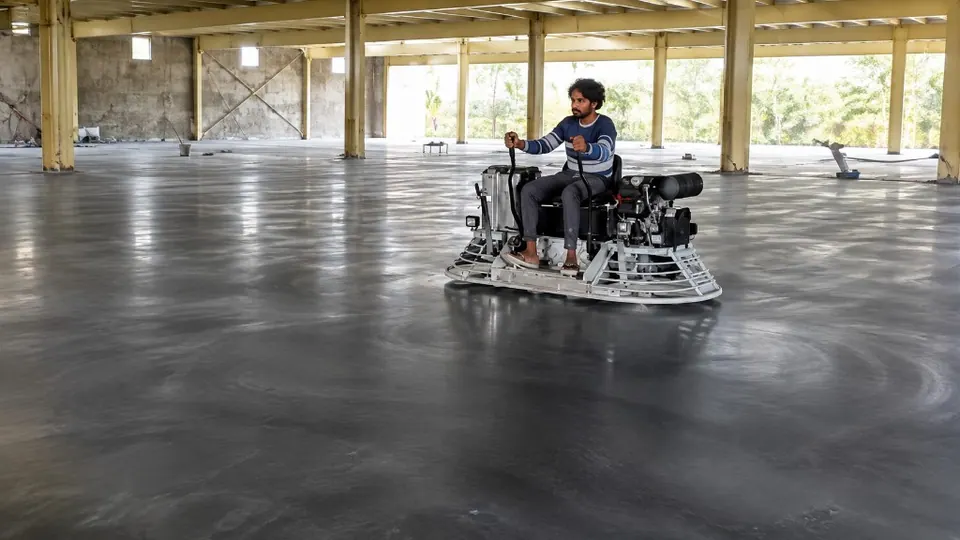
Work follows a site sequence rather than a coating recipe. The slab is poured and struck off, vacuum dewatering is applied with our vacuum unit, and the surface is power-trowelled to the specified finish. Joints, hardeners, and curing are planned around traffic, loads, and the construction programme.
The programme depends on the floor area, site readiness, the concrete specification, weather and the curing time the specification calls for. We confirm timelines after reviewing your project details.
Benefits and limits
A correctly executed VDF floor is denser and stronger at the wearing surface than a slab left with excess bleed water. That helps with dusting, abrasion, and everyday industrial use. It is still a concrete floor: chemical attack, steep hygiene specs, or a seamless coloured finish may need an additional system such as epoxy. We match the system to the site instead of treating VDF as the answer to every brief.
VDF flooring specifications
There is no single “standard” VDF floor. The specification is set for each building from its loads, traffic and use, and it should be fixed before the quotation so every contractor prices the same floor.
- Slab thickness, concrete grade and reinforcement — from the structural design for racking legs, forklift wheels and machine bases
- Sub-base — compacted and levelled, often with a separation membrane, because a weak base cracks even a well-finished slab
- Bay layout — the pour is split into bays so each one can be dewatered and finished while the concrete is workable
- Finish — power-floated and trowelled, with a dry-shake hardener where abrasion is high
- Joints — contraction joints saw-cut at planned spacing, construction joints at bay edges, and filling or sealing later
- Curing — moist curing or curing compound for the full period before the floor is loaded
Common VDF floor problems and how they are avoided
Most floor complaints trace back to execution rather than the concept. A careful VDF contractor plans against them from the start:
- Dusting and a weak surface — avoided by thorough dewatering, correctly timed trowelling and full curing
- Random cracking — controlled with a sound sub-base, joints cut at the right time and spacing, and early curing
- Joint edge damage under forklifts — reduced with proper joint detailing and filling once the slab has shrunk
- Uneven or wavy floors — prevented by setting levels before the pour and checking them during screeding and finishing
VDF compared with other floors
- VDF vs ordinary trowelled concrete — VDF removes surplus water, so the surface is denser and more wear-resistant
- VDF vs epoxy — VDF is the concrete floor itself; epoxy is a coating added on top for chemicals, hygiene or colour
- VDF vs laser screed — laser screeding sets the levels on very large pours; it can be combined with vacuum dewatering and trowelling
- VDF vs tiles or stone — a monolithic VDF slab has no grout lines to break under forklifts and is far quicker to lay over large areas