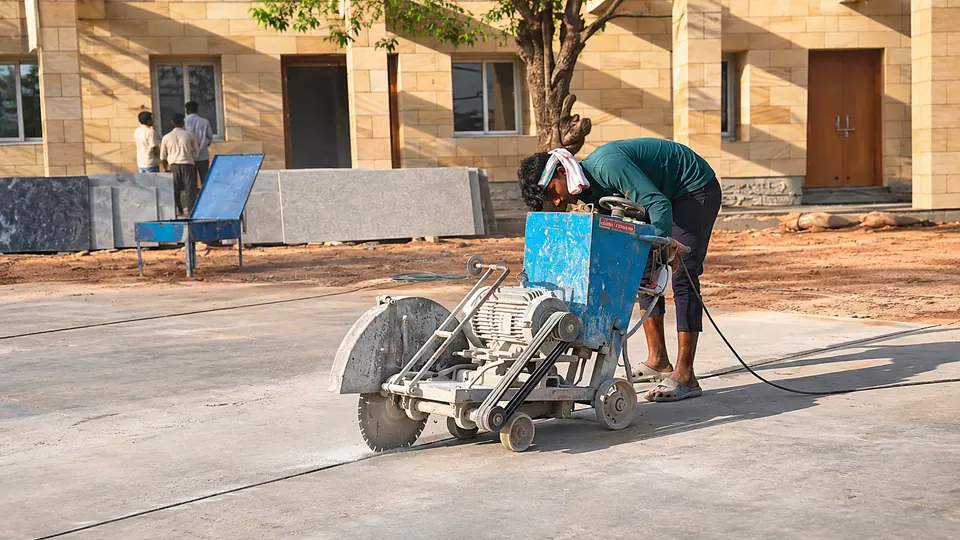
Groove Cutting and Joint Filling in Industrial Concrete Floors
Why concrete floors need joints, when contraction joints are saw-cut, how deep and how far apart, and how joint filling protects edges under forklift traffic.
Every concrete floor shrinks as it dries. If the slab is not given a planned place to crack, it will crack where it chooses. Groove cutting creates those planned places, and joint filling keeps them from becoming the weak point of the floor.
Why concrete floors need joints
As concrete hardens and dries, it loses water and shrinks. The slab is restrained by the sub-base, columns and walls, so tension builds up. Once the tension is greater than the concrete's strength, the slab cracks. Contraction joints are deliberate weakened lines that make the crack form neatly below the saw cut, in a straight line, where it can be filled and maintained.
Types of joints
- Contraction (control) joints — saw-cut grooves that control shrinkage cracking within a bay
- Construction joints — formed where one day's pour meets the next, often with dowels to transfer loads
- Isolation joints — separating the slab from columns, walls, pits and machine bases so they can move independently
When to cut
Timing is critical. Cut too early and the saw ravels the edges and pulls out aggregate. Cut too late and the slab may already have cracked on its own. Joints are normally cut within hours of finishing, as soon as the concrete can be cut cleanly, with early-entry saws used on some projects to cut even sooner. Weather, the concrete mix and the finishing time all affect the right moment, so the crew needs to watch the slab rather than a clock.
Depth and spacing
The cut needs to be deep enough to make the crack form there — commonly about a quarter to a third of the slab thickness, as set by the designer. Joint spacing depends on slab thickness, reinforcement and the concrete; a common rule of thumb for unreinforced or lightly reinforced slabs is a spacing of roughly 24 to 36 times the slab thickness, with bays kept as close to square as possible. Joint layouts should also suit racking lines and truck routes.
Joint filling vs sealing
Not all joint materials do the same job:
- Semi-rigid fillers, such as epoxy or polyurea joint fillers, support the joint edges under hard forklift and pallet-truck wheels
- Flexible sealants keep water, dirt and debris out but give little support to the edges
- Isolation joints usually need a compressible material that allows movement
In warehouses and factories with wheeled traffic, semi-rigid filling is what protects joint edges from chipping (spalling).
When to fill
Ideally joints are filled after much of the drying shrinkage has taken place, because the joints open as the slab shrinks. Filling too early can lead to the filler separating from the joint walls. Where the floor must be used early, joints can be filled and later topped up or refilled as part of maintenance.
Maintaining joints
- Inspect joints regularly, especially on main forklift routes
- Refill joints where the filler has separated or worn
- Repair chipped edges early, before small damage grows under traffic
- Keep joints clean so debris does not wedge into them
Well-planned joints are one of the cheapest ways to protect an industrial floor. ASVDF Flooring provides groove cutting and joint filling as part of VDF floors and as a standalone service for existing floors.
- Groove Cutting
- Joint Filling
- Industrial Flooring