Wear-resistant concrete surfaces
Floor Hardener Application
A floor hardener is a dry-shake topping worked into fresh concrete to create a harder, more abrasion-resistant wearing surface. It is widely used on warehouse and factory floors with forklift and trolley traffic. ASVDF Flooring applies floor hardeners from Shamshabad, Hyderabad, on projects all over India, including Hyderabad, Bengaluru, Chennai, Telangana, Andhra Pradesh, Karnataka, Maharashtra and Odisha.
What is a dry-shake hardener?
Dry-shake hardeners are factory-blended mixes of cement and hard aggregates. Non-metallic hardeners use mineral aggregates such as quartz or corundum; metallic hardeners use iron aggregate for the heaviest wear. Coloured versions are available for zoning.
How it is applied
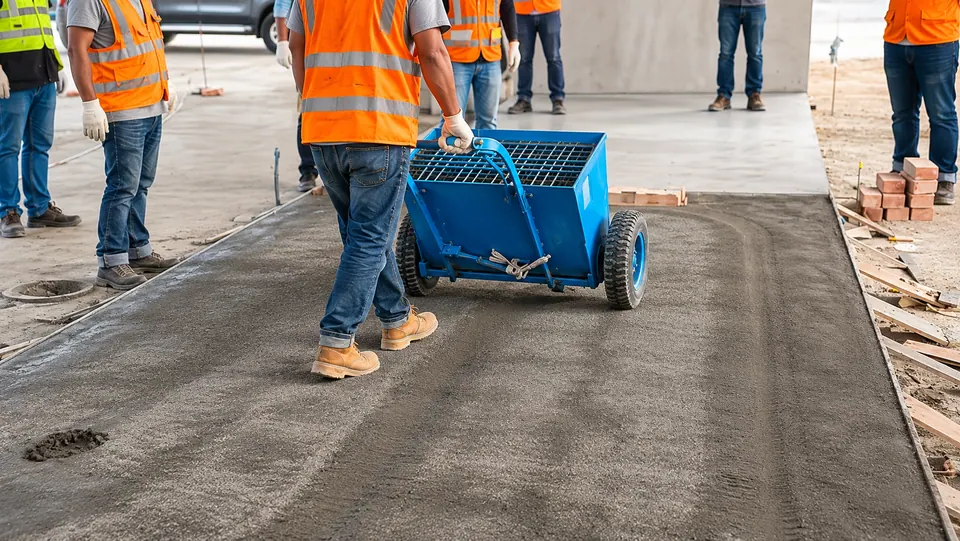
The hardener is broadcast evenly over the fresh slab once bleed water has dissipated, usually in two passes. Each pass is floated in with power trowels so it becomes part of the concrete surface, and the floor is then trowelled to its final finish and cured. Timing is critical: applying too early or trowelling too steeply can cause blistering.
Benefits
- Higher abrasion and impact resistance
- Less dusting from the wearing surface
- Integral with the slab, so no separate layer to peel
- Works well with VDF and laser screed floors
New floors, and existing ones
Dry-shake hardeners can only be applied to fresh concrete during the pour. For an existing floor, the usual options are chemical densification, grinding, or a resin system.