Floor Hardeners for Industrial Concrete: Dry-Shake vs Liquid Densifiers
How dry-shake floor hardeners and liquid densifiers make concrete floors harder and less dusty, where each one fits, and the mistakes to avoid.
A concrete floor wears from the top. Forklift wheels, pallet trucks, dragged loads and daily sweeping all grind at the surface, and a weak surface turns into dust. Floor hardeners are used to make that top layer tougher. There are two main families, and they work in very different ways.
Dry-shake hardeners
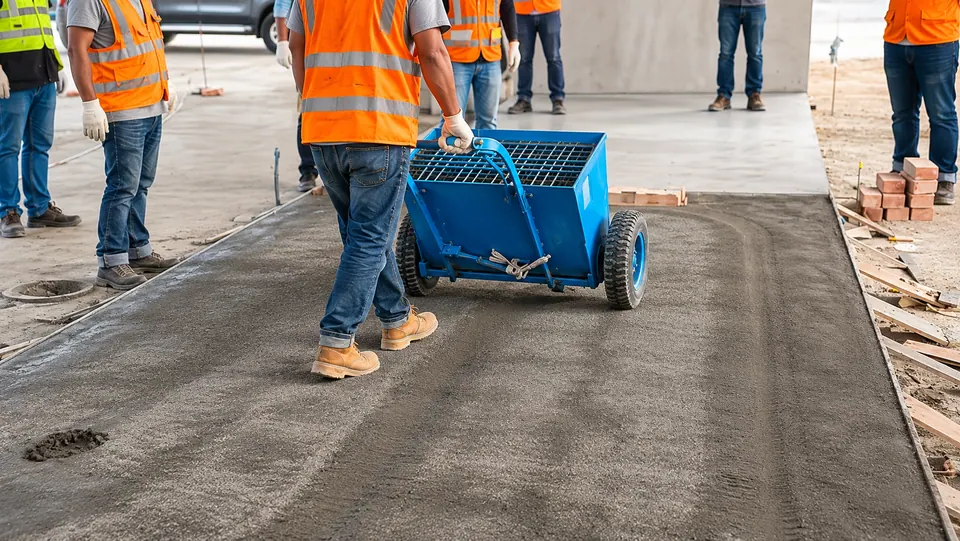
A dry-shake hardener is a pre-blended powder of cement, very hard aggregates and admixtures. It is broadcast evenly onto the fresh concrete during finishing — usually in two passes — and worked into the surface with a power float before trowelling. The result is a hard, dense wearing layer that is part of the slab itself.
- Non-metallic (mineral) aggregates are the most common choice for warehouses and general industry
- Metallic aggregates are used where very heavy abrasion and impact are expected
- Coloured hardeners add colour while hardening the surface
Dry-shake hardener has to be applied at the right time, at the rate given in the specification or by the manufacturer, and spread evenly. On a VDF (Trimix) floor it is applied after vacuum dewatering, during the floating stage.
Liquid densifiers
Liquid densifiers are usually silicate solutions — sodium, potassium or lithium silicate. They are sprayed or spread onto hardened concrete, where they soak in and react with the free lime in the concrete to form additional binding compounds in the pores. This makes the surface harder and much less dusty.
Because they are applied to hardened concrete, densifiers are useful for treating existing floors that have started to dust, and are often used together with grinding and polishing.
Which one to use
- New industrial floors with heavy traffic: dry-shake hardener during finishing gives the toughest surface
- Existing floors that are dusting: liquid densifier treatment, often after light grinding
- Polished concrete finishes: densifier as part of the grinding and polishing process
- Floors that will be coated with epoxy: check compatibility first, as some treatments affect coating adhesion
Common mistakes
- Broadcasting dry-shake too early, while bleed water is still on the surface, or too late, when it can no longer be worked in
- Uneven spreading that leaves weak patches or colour variation
- Skipping proper curing after a hardener has been applied
- Treating a hardener as a fix for a weak or poorly cured slab underneath
- Applying densifier to a dirty or sealed surface where it cannot penetrate
Part of a system, not a cure-all
A hardener improves a good floor; it does not rescue a poor one. Correct dewatering, finishing and curing remain the foundation. ASVDF Flooring applies dry-shake hardeners on new VDF floors and offers concrete densification for existing floors. Tell us about your floor and traffic, and we will recommend the right treatment.
- Floor Hardener
- Concrete Densification
- VDF Flooring